










Why Poorly Fitting Shoes Could Be a Fall Risk After 65
Share
Why Your Shoes Could Be a Fall Risk After 65
The connection between shoe fit, grip, and one of Australia's most preventable health crises.
Most people don't think of their shoes as a safety issue. Comfort, yes. Style, definitely. But safety? That's a conversation most of us have never had, and according to the data, it's one we should have started years ago.
Falls are the leading cause of injury-related hospitalisation in Australians aged 65 and over. They account for a staggering proportion of serious injury, long-term disability, and loss of independence among older adults. Footwear is one of the most modifiable risk factors involved, yet it's rarely the first thing people think to address.
This is the conversation Comfort Co is here to have.
The scale of the problem in Australia
The numbers are confronting. In the 2022–23 financial year, there were 238,055 fall-related hospitalisations in Australia, making up 43.4% of all injury-related hospital admissions. Older Australians are at the centre of that figure.
The consequences go far beyond a bruised knee. Australians aged 65 and over are 8 times as likely to be hospitalised and 68 times as likely to die from a fall compared to younger adults. Half of all fall-related hospitalisations in that age group involve a fracture. The average hospital stay after a fall is 9.5 days.
The financial cost is significant too. Treatment of fall-related injuries in older Australians cost over $4.7 billion in 2021–22. Beyond the economics, falls often trigger a cycle of reduced confidence, social withdrawal, and declining independence that is difficult to reverse.
Falls are the leading cause of injury deaths among older Australians, accounting for 71% of all injury fatalities in that age group. Most occur on the same level: a slip, trip, or stumble, not from heights or dramatic incidents.
Where shoes fit in
Falls are multi-factorial, meaning no single cause explains them all. Age-related changes in balance, muscle strength, vision, and medication effects all play a role. Footwear, however, sits in a particularly important position: it's one of the easiest risk factors to actually change.
The research on this is clear. A University of New South Wales review found that footwear directly influences balance and the risk of slips, trips, and falls by altering sensory feedback to the foot and ankle, as well as the frictional conditions between the shoe and the floor. Wearing shoes with worn soles, minimal tread, or poor heel security changes how the foot interacts with the ground on every single step.
Ill-fitting shoes don't just cause discomfort. A comparative study published in the Journal of Applied Gerontology found that people wearing improperly fitting footwear scored lower on balance assessments and reported higher levels of fear of falling than those in well-fitted shoes. Poor fit alters the distribution of pressure across the foot, which compounds any existing weakness in balance or gait.
The problem is surprisingly common across the population. A BMC Geriatrics study found that 72% of older adults attending a geriatric day hospital were wearing footwear that didn't fit correctly on either foot, and 90% had shoes with smooth, worn, or partially worn soles. Many were also relying on slippers at home, one of the most significant indoor fall risks identified in the literature.
Research consistently identifies four shoe characteristics linked to increased fall risk: poor fit (too loose or too narrow), worn or smooth outsoles with reduced grip, inadequate heel fixation, and high or unstable heel height. Addressing even one of these can meaningfully reduce risk.
Why older feet change, and why most shoes don't account for it
One of the reasons ill-fitting footwear is so prevalent among older adults is that feet genuinely change with age. Many people haven't had a proper fitting since childhood. Over time, feet can widen, arches can flatten, and conditions like bunions or hammertoe can shift the shape of the foot significantly. A shoe that fit well at 45 may be entirely wrong at 65.
Standard footwear sizing doesn't account for this. Half sizes only address length, not width. Most shoes don't offer genuine width options, don't accommodate custom orthotics without sacrificing fit, and don't provide any meaningful way to fine-tune the fit once you've bought them. The result is a lot of older Australians walking around in shoes that are subtly wrong for their feet, often have been for years.
How Revere addresses it
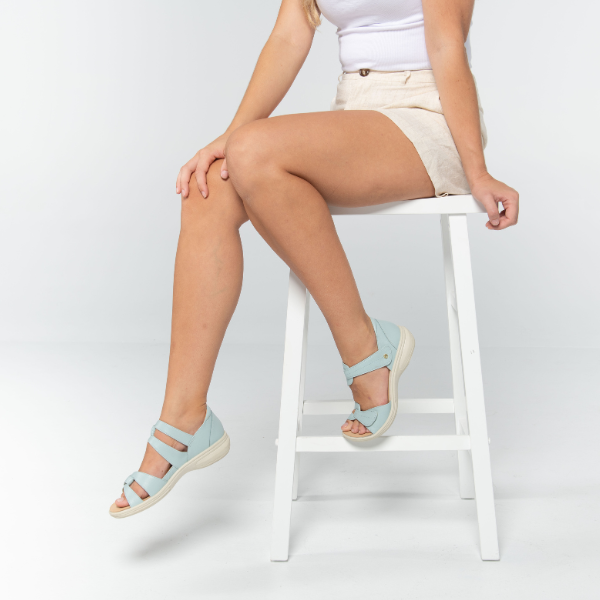
Revere was designed specifically with this problem in mind. Every pair of Revere shoes comes with a Personalised Fit Kit and a set of adjustable features that allow the wearer to dial in the fit precisely, something no standard shoe can offer.
-
Personalised Fit Kit Included with every pair: a full-length filler, half forefoot fitter, and shoe horn. The fillers can be trimmed and placed under the footbed to reduce volume, eliminate heel slip, and customise the fit for narrower feet without needing a different size.
-
Removable footbed for custom orthotics The contoured footbed lifts out entirely, making room for a prescribed orthotic device without forcing a size compromise. Orthotics in regular shoes often require going up a size, which can create the very looseness that increases fall risk.
-
Medium and wide width options Available in both medium and wide widths across the range, with strap extensions on sandal styles to accommodate feet that change shape during the day or in warmer weather.
-
Slip-resistant outsoles Revere's outsoles are designed with slip resistance as a standard feature, not an afterthought. That means the shoe-to-floor interface, one of the key variables in fall prevention research, is built with stability in mind from the start.
-
Adjustable closures and strap fixation Secure heel fixation is one of the most evidence-backed features in fall-prevention footwear research. Revere's adjustable hook-and-loop straps and structured heel counters keep the foot seated correctly within the shoe on every step.
The result is a shoe that can be precisely fitted to an individual foot, including feet that have changed shape with age, feet with conditions, or feet that are between standard sizes. That precision matters. A well-fitted shoe that secures the heel, provides grip underfoot, and supports the arch changes how the foot behaves while walking.
The takeaway
Falls are not simply an inevitable part of getting older. They are, in many cases, preventable, and footwear is one of the most accessible places to start. The data is consistent: a significant proportion of older Australians are wearing shoes that don't fit correctly, have worn grip, or don't adequately secure the heel. Each of those factors independently increases risk.
Revere doesn't eliminate every fall risk. No shoe does. What it offers is a serious, evidence-aligned approach to footwear fit, one that addresses the variables that research has identified as important, with tools that let the wearer actually customise the outcome.
For anyone over 65, or anyone choosing footwear for a parent or loved one, that's worth thinking about. The right shoe isn't just a comfort decision. It's a safety one.
Footwear designed for a precise, personalised fit, with the features that support stability and confidence at every age.
Shop Revere NowAustralian Institute of Health and Welfare. Falls in older Australians 2019–20. aihw.gov.au
Australia and New Zealand Falls Prevention Society. Info about falls. anzfallsprevention.org
Tunstall Healthcare. Slip and Fall Statistics in Australia and New Zealand (2025). tunstallhealthcare.com.au
O'Rourke B et al. Does the shoe really fit? BMC Geriatrics, 2020. bmcgeriatr.biomedcentral.com
Kim IJ et al. Enhancing Footwear Safety for Fall Prevention in Older Adults. PMC, 2024. pmc.ncbi.nlm.nih.gov
Menant JC et al. Optimizing footwear for older people at risk of falls. Journal of Rehabilitation Research and Development, 2008. pubmed.ncbi.nlm.nih.gov
Eroglu S et al. Investigating the effects of appropriate fitting footwear on functional performance level, balance and fear of falling in older adults. Archives of Gerontology and Geriatrics, 2021. sciencedirect.com