










The Comfort Co's Best Arch Support Insoles for Flat Feet in Australia: Our Picks, and When You Don't Need One
Flat feet need an insole with an arch that holds its shape under your weight, a heel that keeps your foot steady, and a length that suits your shoes. Get those three right and everyday shoes start to feel properly supported.
This list isn't a replacement for seeing a podiatrist, but it's a good place to start if you're shopping for your first insole.
Maybe a podiatrist mentioned your arches on the way out of an appointment. Perhaps a friend has been going on about how much better they feel since getting arch support for their flat feet, and you've noticed the same tired, achy feet. Or maybe your shoes wear out faster than they should. Whatever the case, you've landed on the right question, and with a flat foot the wrong insole is easy to feel.
For most flat feet, the best arch support insole is the Vitasole Active Full Length Orthotic Insole, because its firm-density base holds up under a foot that wants to roll in, and the included Support Booster lifts the arch further if you need it. For shoes where the footbed won't lift out, the Vionic Relief 3/4 is the one to grab.
Not sure your arches are flat at all? Our guide to understanding your arch type will tell you in a minute, and our Podiatry Corner explainer on what flat feet are covers the why. Dealing with heel pain as well? Our best insoles for plantar fasciitis guide is the better match.

The best arch support insoles for flat feet in Australia
The best arch support insoles for flat feet in Australia are firm, contoured insoles with an arch that doesn't collapse and a heel cup that keeps the foot steady. Our picks lead with Vitasole, then bring in Aetrex, Vionic and Realign where they solve a problem Vitasole doesn't.
| Insole | Best for | Why it works for flat feet | The trade-off |
|---|---|---|---|
| Vitasole Active Full Length (top pick) | Sneakers, walking and work shoes with a removable footbed | Firm-density arch that holds under load, plus a Support Booster to raise it | Feels firm for the first few days |
| Aetrex Casual Comfort Posted | Feet that roll inward, and anyone who wants a foot scan first | Posted support that Aetrex builds specifically for low to flat arches | Premium price, and a scan means a trip to a store |
| Vionic Relief 3/4 | Shoes with a footbed that won't lift out | A deep heel cup for rear-foot stability, made with flat feet in mind | Nothing under the forefoot; best in flat or low-heeled shoes |
| Realign Advantage Lite | A stiff flat foot that finds a tall arch uncomfortable | A lower arch profile with a thermoplastic stabiliser for steady, mild support | Gentler support than the Vitasole Active |
| Vitasole Comfort Full Length | Your first arch support insole, and long days on your feet | Medium-density support heel to toe, with the same Booster | Less structure under the arch than the Active |
Our top pick: Vitasole Active Full Length Orthotic Insole
With a flat foot the arch sits low, so a soft insole squashes flat exactly where you want the support. The Vitasole Active Full Length is firm-density from heel to toe, so the arch holds its shape under your weight through a long day, rather than squashing flat by lunchtime. It suits flat, high and neutral arches, and the included Support Booster raises the arch profile if the standard height isn't enough for you.
It replaces your shoe's removable footbed rather than sitting on top. The catch is the feel. Firm support under a flat arch is very noticeable for the first few days, and if your foot is stiff rather than flexible, the Realign Advantage Lite below is the kinder start.

Choose if:
- your shoes have a removable footbed
- your arch flattens or your foot rolls in
- you want firm support you can raise with the Booster
For feet that roll inward: Aetrex Casual Comfort Posted
Many Aetrex orthotics come in a posted version, and that's the one built for flat feet. The Casual Comfort Posted (L620) adds extra support along the inside of the foot, which Aetrex recommends for low to flat arches and feet that roll inward. It pairs that with a memory foam layer and an antimicrobial top cover, and at about 5 mm thick it suits sneakers, walking shoes and boots. There is a men's version too.
Better still, pop into any Comfort Co store for a free Aetrex foot scan. It maps your arch in 3D, so our team can confirm whether posted support is right for you before you buy. Aetrex sits at the premium end, and the scan means getting to a store (or one of our partners with an Aetrex scanner), but it takes the guesswork out.

Choose if:
- your feet roll inward
- you want a foot scan before you buy
- you wear sneakers, walking shoes or boots
For shoes with a fixed footbed: Vionic Relief 3/4
Plenty of good shoes have a glued-in footbed, and stacking a full-length insole on top of one lifts your heel out of the back of the shoe. The Vionic Relief 3/4 stops short of the toes and leans on a deep heel cup, which keeps the back of a flat foot steadier while the medium-density arch does its job. Vionic designed it with podiatrists and made it with flat feet in mind. It leaves the forefoot bare and works best in flat or low-heeled shoes.

Choose if:
- your shoe's footbed won't lift out
- you want a deep heel cup to steady your foot
- you wear flat or low-heeled shoes
If a tall arch feels like a golf ball: Realign Advantage Lite
Softness and arch height are two different dials, and most insole lists treat them as one. Some flat feet are flexible and happily take a tall arch. Others are stiff, and a tall arch feels like standing on a golf ball. The Realign Advantage Lite was designed by podiatrists with a reduced arch profile and a thermoplastic stabiliser, so it gives steady support without pushing hard into the arch. You trim it to length at home. If your arch collapses a lot, step up to the Vitasole Active instead.

Choose if:
- a tall arch feels like standing on a golf ball
- your flat foot is stiff rather than flexible
- you want steady, mild support you trim to fit
For your first insole: Vitasole Comfort Full Length
The Vitasole Comfort Full Length is the Active's softer sibling. If you're brand new to arch support, this is definitely the way to go. It has the same heel-to-toe coverage and Support Booster, at medium density, with more give for walking and standing all day. Choose it if firm support has felt like too much in the past. The trade-off is less structure under the arch, so a foot that rolls in noticeably will get more from the Active or the Aetrex Posted.

Choose if:
- you're brand new to arch support
- firm insoles have felt like too much before
- you're on your feet all day
Full length or 3/4? Matching the insole to your shoe
One check in the shoe decides the length: can you lift the footbed out?
- It lifts out. Swap it for a full-length insole. Shoes built this way are orthotic-friendly footwear, and they give a flat foot the most room to work with.
- It's fixed. Choose a 3/4 insole that sits on top and stops before the toes, like the Vionic Relief 3/4.
- Don't stack. A full-length insole on top of an existing footbed pushes your heel up and out of the heel counter, which is the opposite of the stability a flat foot needs.
- Walk a lap. If your heel slips once the insole is in, the shoe is now too shallow, and a deeper pair will do a better job.
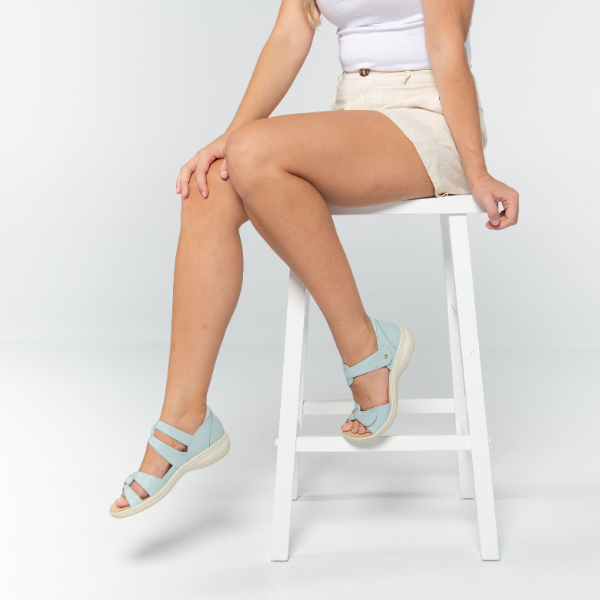
The shoe still matters. A firm heel counter and a sole that doesn't twist easily in your hands will back up any insole, and our guide to the best arch support shoes for women has pairs that do much of the work on their own. Sandals and thongs are trickier. Most insoles won't stay put in an open shoe, so look for a sandal with a contoured footbed instead. Funnily enough, Revere sandals do both, with a contoured footbed that lifts out if you'd rather use your own insole.
Getting used to arch support when your arches are flat
If your arch has never had anything under it, the first week with an insole can feel strange. That's normal, and easing in helps.
- Start with an hour or two. Add time each day as your feet settle, rather than wearing it from breakfast to bed on day one.
- Expect to feel the arch. Pressure under the arch is part of the adjustment. Sharp or new pain is different, and a reason to stop and get advice.
- Add the Booster only if you need it. On the Vitasole insoles, give the standard arch a fair go before you add the Support Booster, so you're only changing one thing at a time.
- Replace it when it flattens. If the arch no longer springs back when you press it, it has stopped holding your arch either. Most insole makers recommend replacing them every 6 to 12 months, depending on how much you wear them.3
What makes an insole good for flat feet
Three features carry most of the load: firm arch support that holds under your weight, a heel that keeps your foot steady, and an arch height you can actually live with.
- A firm arch. With a flat foot, the inside of the arch sits close to or on the ground. Support underneath it gives the arch something to rest on, but only if the material doesn't fold flat the moment you stand.
- A stable heel. A deep or contoured heel cup holds the back of the foot in place, so the arch support stays where it should rather than sliding off to one side.
- The right height. Taller isn't automatically better. A flexible flat foot often suits a higher arch; a stiff one usually prefers a lower profile like the Realign Advantage Lite.
Do flat feet always need an insole?
No. Flat feet are common, and if yours aren't causing pain or problems, health services say you don't need treatment.1 Flat feet shouldn't stop you doing any activity, sport included, and plenty of people never put anything in their shoes at all.2
However, if your feet, ankles or legs feel tired or achy after a long day, an arch support insole is an easy, low-cost thing to try. What it won't do is change the shape of your foot. It supports the arch while you're wearing it, and that's all.2
When to see a podiatrist
Ask yourself one question: are your flat feet painful, stiff, or different from how they used to be (for example, only one foot has flattened)? If the answer is yes, book a podiatrist or see your GP before trying another insole.12 A podiatrist can also tell you whether an off-the-shelf insole is enough or a custom orthotic is the better step.
Find the insole that suits your arches
Shop every insole online, or pop into any Comfort Co store for a free Aetrex foot scan and we'll match one to your arches.
Shop insolesFrequently asked questions
What are the best arch support insoles for flat feet in Australia?
The best arch support insoles for flat feet combine a firm arch that holds its shape, a stable heel and the right length for your shoe. Our top pick is the Vitasole Active Full Length Orthotic Insole. The Aetrex Casual Comfort Posted suits feet that roll inward, the Vionic Relief 3/4 suits shoes with a fixed footbed, and the Realign Advantage Lite suits a stiff flat foot that prefers a lower arch.
Should insoles for flat feet be firm or soft?
Firm, with some cushioning on top. A soft insole feels nice at first but flattens under your weight, which leaves a flat arch with nothing to rest on. If firm support feels like too much, try a lower arch height before you try a softer material.
Can insoles fix flat feet?
No. An insole supports your arch while you are wearing it and can help with comfort, tiredness or aching, but it will not change the shape of your foot.
Do I need insoles if my flat feet don't hurt?
Not necessarily. Flat feet that aren't causing pain or problems don't need treatment. Many people choose an arch support insole for extra comfort on long days, but it is a choice rather than a must.
Full length or 3/4 insoles for flat feet?
Full length if your shoe has a removable footbed, because it supports the whole foot and replaces the original. Choose a 3/4 insole for shoes with a fixed footbed. Never stack a full-length insole on top of an existing footbed.
How long does it take to get used to arch support with flat feet?
It varies, but start with an hour or two a day and build up as your feet settle. Pressure under the arch is normal at first. Sharp or new pain is a reason to stop and get advice from a podiatrist.
Still not sure which arch suits you? Ask a Comfort Concierge and we'll match an insole to your feet and your shoes.
References
- Healthdirect Australia. Flat feet. healthdirect.gov.au
- NHS. Flat feet. nhs.uk
- Aetrex. How long do insoles last? aetrex.com